
Shipping Horses Internationally: How Importing a Friesian Actually Works
The short version
Importing a horse runs in six stages: choose the horse and agree terms, appoint an export agent, complete pre-export testing and paperwork, fly, clear USDA quarantine on arrival, and transport onward to your yard.
Expect the whole process to take several weeks to a few months from agreement to arrival, and expect the transport and import costs to represent a significant addition to the purchase price rather than a rounding error.
Stage 1: buying the horse
Everything downstream is easier if the purchase itself is done properly.
Get the horse independently vetted before it travels. A pre-purchase examination by a veterinarian you appointed, not the seller's, is the single most valuable thing you can buy at this stage. Importing a horse and then discovering a soundness problem is an expensive and demoralising sequence.
Confirm the paperwork is complete and correct: KFPS or FHANA registration, DNA-verified parentage, passport and microchip details matching the horse in front of you. Errors in identification documents cause real delays at export. If you want the detail on reading Friesian paperwork, we cover it in what KFPS registration and predicates mean.
Agree in writing who is responsible for what: who pays for transport, who carries the risk in transit, who covers veterinary costs if the horse fails a pre-export test, and at what point ownership actually transfers.
Stage 2: appointing an export agent
Do not attempt this yourself. Specialist equine shipping agents exist because the process involves aviation logistics, veterinary certification and government paperwork in at least two countries simultaneously.
A good agent will coordinate the pre-export testing schedule, book the flight and air stall, arrange ground transport at both ends, prepare and lodge the documentation, and manage the quarantine booking. They will also know which airline routes and which quarantine facilities are currently running smoothly, which is knowledge you cannot get from a website.
Ask any prospective agent how many horses they have moved on your specific route, who the flying groom will be, what happens if the horse fails a pre-export test, and exactly what their quoted price includes. Quotes that look cheap usually exclude quarantine, ground transport or customs clearance.
Stage 3: pre-export testing and paperwork
This is the stage that sets your timeline, because tests have to happen in a defined window before departure and some take time to return.
Requirements vary by country of origin, destination and the horse's sex, and they change. Your agent and the destination authority are the definitive source. Broadly, expect:
- Blood testing for the diseases the destination country screens against. For horses entering the United States this typically includes equine infectious anaemia, dourine, glanders and equine piroplasmosis, with additional requirements depending on origin.
- A period of pre-export isolation at an approved facility, with veterinary supervision.
- A health certificate issued by an official veterinarian in the exporting country, within a specified window before travel.
- Identification documents matching the horse exactly, including passport and microchip.
- An import permit where the destination requires one.
Two points cause most of the trouble. First, stallions face additional requirements, particularly around contagious equine metritis, and their quarantine on arrival is longer and more involved than for mares and geldings. If you are importing a stallion, budget more time and more money. Second, piroplasmosis is the test that most often disqualifies a horse from entering the United States, and it is worth testing early rather than discovering a positive result late in the process.
Stage 4: the flight
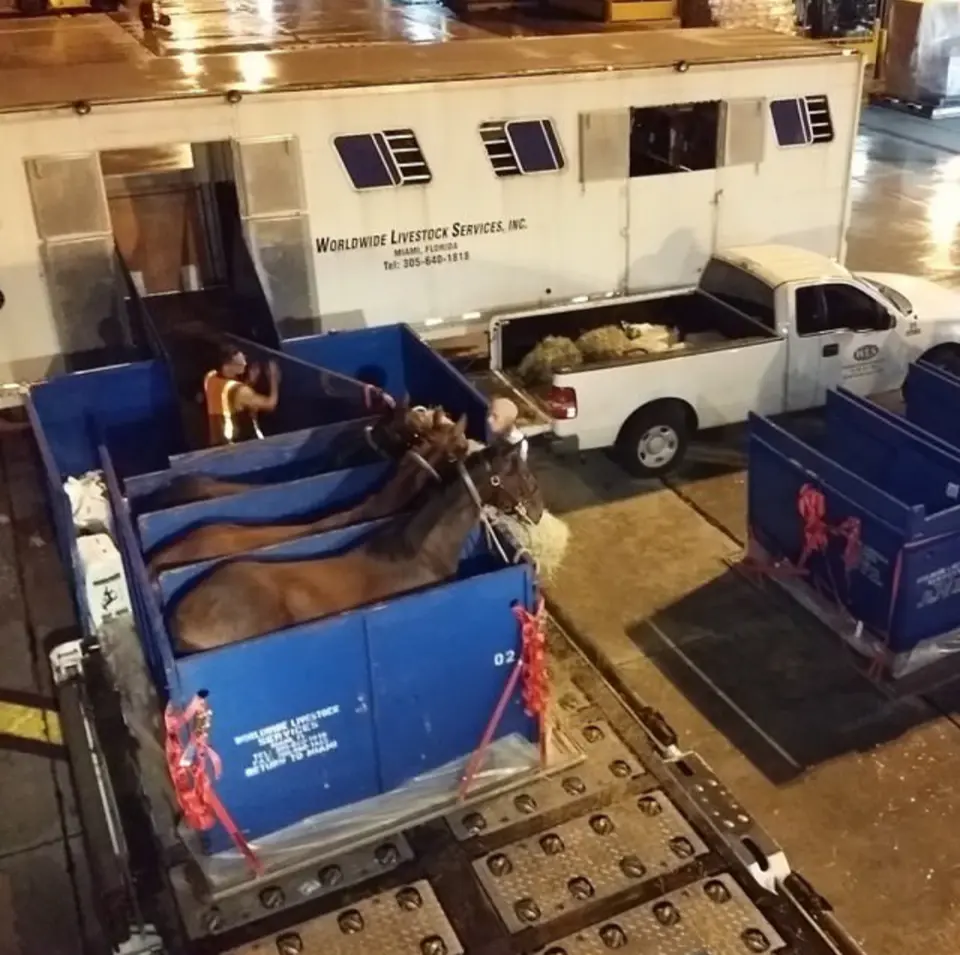
Horses fly in purpose-built air stalls loaded onto freight aircraft, typically in configurations of one, two or three horses per stall. A single-horse configuration gives the most space and costs the most; three to a stall is the economy option.
Horses are accompanied by professional flying grooms who monitor them throughout, offer water and hay, and manage any problems in the air. Most horses travel well. The parts they find hardest are usually the loading and the road transport at either end rather than the flight itself.
Sedation is generally avoided in favour of good handling, because a sedated horse manages its own balance less well. Standing wraps, shipping boots and travel rugs are used at the groom's discretion, and your agent will advise on what to send with the horse. We keep the stable and travel supplies we use for our own horses' transport if you need to kit out for arrival.
Flight time from northern Europe to the eastern United States is typically under ten hours, though the horse's total journey door to door will be considerably longer once ground transport at both ends is counted.
Stage 5: quarantine on arrival
Every horse entering the United States passes through a USDA-approved import facility on arrival. This is not optional and it is not negotiable.
Mares and geldings typically complete a short quarantine, commonly around three days, during which they are examined and tested. Stallions undergo a substantially longer process because of contagious equine metritis testing requirements, which can run to several weeks and involves test breeding or laboratory culture protocols depending on the facility.
Quarantine is charged daily and it is a real line item. It also means your horse's arrival date at your yard is not the date it lands.
You will not have access to the horse during quarantine. The facility handles feeding, care and testing, and will contact you or your agent if anything needs a decision.
Stage 6: onward transport
Once released, the horse travels by road from the quarantine facility to your yard. For a horse that has just flown a continent and stood in quarantine, this last leg matters more than people expect.
Use a professional equine transporter. Plan the arrival for daylight if you can. Have a quiet stall ready, water available, and hay in front of the horse. Expect it to be tired, possibly dehydrated, and unsettled for several days.
Do not plan to ride for at least a few days. Give the horse time to rest, rehydrate and settle before asking anything of it, and watch closely for signs of shipping fever, a respiratory infection associated with long transport that typically presents as fever, dullness or nasal discharge in the first days after arrival. Take temperatures twice daily for the first week and call your vet at the first sign of a raised temperature.
What it costs
Import costs are made up of several components, and quotes that show only one of them are misleading. Budget for:
- Air transport, priced by stall configuration
- Pre-export isolation and testing, including veterinary fees
- Export documentation and permits
- Ground transport in the country of origin
- USDA quarantine, charged daily and materially higher for stallions
- Customs clearance and import duties where applicable
- Domestic ground transport from quarantine to your yard
- Transit insurance, which is strongly recommended
The total varies substantially by route, season, stall configuration and the horse's sex. A stallion costs considerably more to import than a gelding because of quarantine requirements alone.
Get a written, itemised quote from your agent covering every line above. The most common unpleasant surprise in horse importing is a quote that covered the flight and nothing else.
Practical advice from experience
Insure the horse in transit. It is a small cost against a large risk.
Budget in time as well as money. Testing windows, flight schedules and quarantine availability all constrain the timeline, and they do not always align neatly.
Consider the sex of the horse early. If you are choosing between two similar horses and one is a stallion, understand the import cost and timeline difference before you decide rather than after.
Buy the horse you actually want. Import costs are broadly fixed regardless of the horse's value, which means they represent a much larger proportion of the total on a cheap horse than an expensive one. If you are going to the expense of importing, it usually makes sense to import a horse genuinely worth importing.
Ask about the whole journey. A horse's welfare in transit is determined by the ground transport and the handling as much as by the flight.
If you are buying from us, we handle worldwide delivery and will walk you through every stage of this. You can browse our available Friesian horses, and Queran, a KFPS Friesian stallion is a good example of a horse whose import planning would need the longer stallion timeline.
Frequently Asked Questions
In Conclusion
Shipping horses internationally is a well-established, safe and highly procedural business. It is not something to be afraid of, but it is something to plan properly and budget honestly for. The essentials: vet the horse before it travels, appoint a specialist agent with experience on your route, start the testing early because piroplasmosis is the common disqualifier, understand that stallions cost more and take longer, and get an itemised quote that covers quarantine and ground transport rather than just the flight. If you are considering a Friesian from abroad and want a straight answer on what the whole process would cost and how long it would take, [contact our team](/contact) with the horse's details. If this is also your first horse, read [whether a Friesian suits a first-time owner](/blog/friesian-horse-for-beginners) first, because importing and first-time ownership together is a demanding combination.