
The short answer
Yes, for the right beginner buying the right individual horse. A mature, well-started Friesian gelding with a calm mind, good ground manners and several years of consistent handling can be an excellent first horse.
No, if you are buying young, green, or on a budget that only covers the purchase. A three-year-old Friesian is not a beginner's horse regardless of how sweet he is, and a Friesian kept on a shoestring becomes an unhappy horse with skin problems and an owner who resents it.
The breed is not the deciding factor. The individual, and your preparation, are.
Why Friesian temperament suits nervous riders
This is where the breed genuinely earns its reputation.
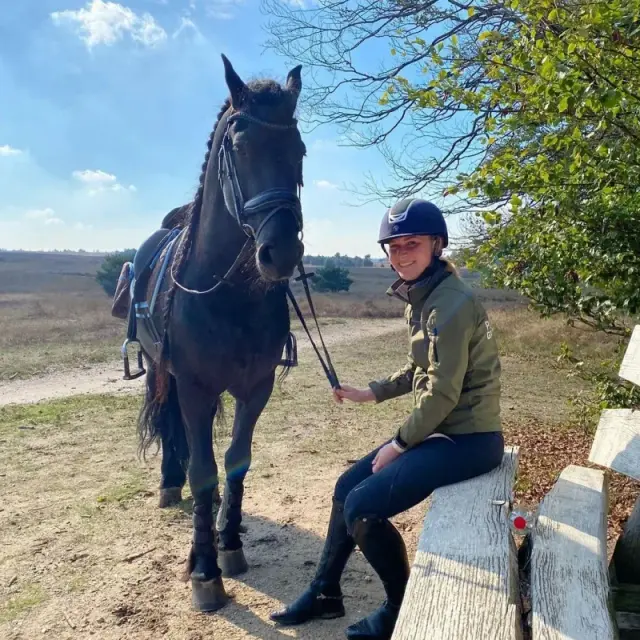
Friesians are typically calm, steady and strongly people-oriented. They tend to seek out human company rather than tolerate it, and a well-handled Friesian will often follow you around a field for the company alone. Owners routinely describe them as more like a large dog than a horse, and that is not sentimentality; it reflects generations of selection for a horse that worked closely with people in harness and in hand.
For a beginner, three things follow:
- They are forgiving. A Friesian will generally absorb an unbalanced rider, a mistimed aid, or an accidental jab in the mouth without punishing you for it.
- They are unspooky. The breed's tolerance of noise, crowds and unfamiliar objects is why Friesians appear so often in film, parades and liberty exhibitions.
- They want to get it right. Friesians are willing workers who generally try to understand what you are asking rather than argue about it.
The honest counterpoint is that some Friesians are behind the leg. A horse that is calm can also be a horse that does not move forward readily, and a beginner without instruction can end up nagging with the leg rather than teaching a response. This is fixable with a good trainer and worth knowing before you buy.
What the care actually involves
This is the part the photographs do not show, and it is where first-time Friesian owners are most often blindsided.
Feather care. The long hair on the lower legs is a defining feature and a genuine ongoing job. Feathering traps moisture and debris, and legs that stay damp are prone to skin conditions, commonly called scratches or pastern dermatitis. In a wet or humid climate, and Florida is both, this moves from an occasional problem to a routine management task. You will be checking and drying legs regularly, not seasonally.
Mane and tail. The long, thick mane and tail that make the breed look the way it does need consistent detangling and protection if you want them to stay that way. Many owners keep them braided or bagged between shows.
Coat and sun. A black coat in a hot, sunny climate fades and can bleach reddish. Shade, fly sheets and appropriate turnout timing all matter more than they would for a bay horse.
Heat management. A large, black, heavy-coated horse in a Florida summer needs shade, airflow and sensible work timing. This is a real consideration, not a footnote.
None of this is difficult. All of it is time, and it is time every week rather than occasionally. We keep the grooming and stable supplies we use on our own horses for exactly these jobs.
The real cost of ownership
Budget for the year, not the purchase. This single mistake causes more unhappy first-horse stories than any other.
Purchase price is the smaller number over any realistic ownership period. Beyond it you are committing to:
- Board or land, and a Friesian needs more space and more shelter than a smaller horse
- Feed, scaled to a horse of 15.2 to 17 hands
- Farrier, every five to eight weeks, indefinitely
- Routine veterinary care, vaccinations, dental work, worming
- Emergency veterinary reserve, which is not optional; colic surgery costs what a decent used car costs
- Insurance, mortality and major medical
- Tack, sized for a large horse, and a Friesian's build often needs careful saddle fitting
- Instruction, which for a first-time owner is a requirement rather than a luxury
- Grooming and skin care consumables, more than for a clean-legged breed
If that list makes you uneasy, that is useful information rather than a reason to give up. It may mean waiting a year, or it may mean a different breed. We compare the practical economics directly in how Friesians compare with Morgans, and for many first-time owners the Morgan is the more sensible answer.
What to look for in a first Friesian
If you have read this far and still want one, this is the specification to buy against.
Age: 8 to 15 years. Old enough to be settled and educated, young enough to have years of work ahead. Avoid anything under six as a first horse.
Sex: gelding. Mares can be wonderful, but a gelding is the lower-variance choice for a first horse. A stallion is not a first horse under any circumstances, regardless of temperament.
Training: genuinely well-started, ideally further. You want a horse that has been ridden consistently by more than one person and behaves predictably for a stranger. "Green broke" and "first horse" do not belong in the same sentence.
Temperament: proven, not promised. Visit more than once. Ride the horse yourself. Handle it on the ground, pick out its feet, see it caught from the field, see it clipped or bathed if you can.
Paperwork: verified. Ask for KFPS or FHANA registration, DNA-verified parentage, and genetic testing for dwarfism and hydrocephalus. We explain how to read all of it in what KFPS registration and predicates mean.
Vetting: independent and non-negotiable. Your vet, not the seller's, and a vet who knows the breed.
Richard, a Friesian gelding and Pieter, a Friesian gelding are the type we point first-time owners toward: mature geldings with settled minds and consistent handling behind them.
Mistakes that go wrong most often
Buying young because it is cheaper. A green horse and a green rider is the single most reliable way to produce a frightened owner and a confused horse. The money you save at purchase is spent on training, or on selling the horse a year later.
Buying from photographs and video alone. Especially internationally. Video shows you a horse on a good day, handled by someone who knows it. If you are buying from abroad, understand the full process first, including the documentation and quarantine involved.
Underestimating the climate. A heavy black horse with feathered legs in a humid subtropical climate is a management commitment. Plan for it rather than discovering it.
Skipping instruction. The best thing a first-time owner can buy after the horse is regular lessons. It protects the horse as much as the rider.
Buying the breed instead of the horse. Every Friesian is not the temperament described above. Judge the animal in front of you.
So should you buy one?
Buy a Friesian as your first horse if you can answer yes to all of these:
- You have budgeted for a full year of ownership, including an emergency reserve.
- You have arranged regular instruction.
- You are buying a mature, well-started horse, sight seen and independently vetted.
- You understand the feather, coat and heat management the breed asks for, and you are willing to do it weekly.
- You want this specific horse, not just the idea of a black horse.
If any answer is no, that is worth solving before you buy rather than after. Waiting six months and buying the right horse is a far better outcome than buying now and selling in a year.
Frequently Asked Questions
In Conclusion
Friesians are one of the kindest, most people-loving breeds you can own, and that makes them genuinely suitable for beginners in a way many prettier breeds are not. But they are large, expensive to keep, and higher-maintenance than their photographs suggest, and the difference between a wonderful first horse and an expensive regret is almost entirely down to which individual you buy. Buy mature. Buy well-started. Buy vetted. Budget for the year. Book the lessons. Do those five things and a Friesian can be the horse you keep for twenty years. You can [browse our available Friesian horses](/horses) to see what a well-started, first-owner-suitable Friesian actually looks like on paper. If you want a straight answer about whether a particular horse suits you, [contact our team](/contact) and tell us honestly about your experience and your setup. If the answer is that you are not ready yet, we will tell you that too.