
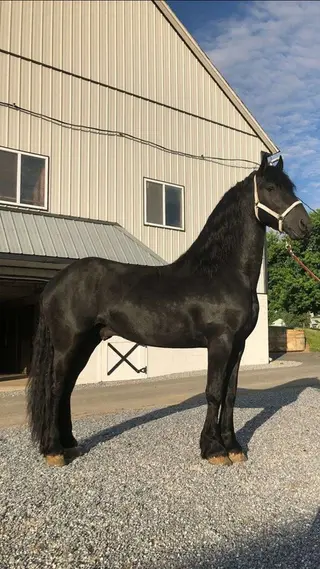
Friesian vs Morgan Horse: Which Breed Actually Fits Your Life?
The short answer
Choose a Morgan if you want a hardy, versatile, long-lived horse that costs less to buy and less to keep, suits a wide range of disciplines, and forgives a less experienced owner.
Choose a Friesian if you specifically want the presence, the movement and the temperament that made the breed famous, you are drawn to dressage or driving, and you have the budget and the setup to look after a large horse with high-maintenance feathering.
Both are willing, people-oriented breeds. Neither is a mistake. But they ask different things of you.
Origins: why these breeds are so different
The Friesian comes from Friesland in the northern Netherlands and is one of Europe's oldest breeds, shaped as a carriage and light draught horse and later refined for elegance and movement. Its studbook, the KFPS, was founded in 1879 and remains unusually strict about what may be bred. If you want the detail on that, we have written separately about what KFPS registration and predicates mean.
The Morgan is one of the earliest American breeds and traces to a single foundation stallion, a small bay horse named Figure who later took the name of his owner, Justin Morgan, in late-1700s Vermont. He was famous for out-pulling, out-walking and out-racing bigger horses, and for passing that ability on with unusual consistency. The Morgan was bred to work, and it shows.
That difference in purpose explains almost everything that follows. The Friesian was bred to look magnificent doing a job. The Morgan was bred to do the job.
Size and build
| Friesian | Morgan | |
|---|---|---|
| Typical height | 15.2 to 17 hh | 14.1 to 15.2 hh |
| Build | Tall, heavy-boned, powerful, upright neck | Compact, muscular, deep-chested |
| Colour | Black, almost exclusively | Bay, chestnut, black and many others |
| Distinguishing features | Long mane and tail, heavy leg feathering | Expressive head, strong hindquarters |
The size gap matters more than people expect. A 16.2hh Friesian is a substantial animal to handle from the ground, to mount, to tack up and to load. Riders under about 5'4" often find a Morgan a far more comfortable everyday partner, and taller riders sometimes find a Morgan too small to look balanced.
Colour is worth naming plainly, because it drives more Friesian purchases than anyone admits. The Friesian is very nearly always black, and that is a large part of the breed's appeal. It is not, on its own, a reason to buy one.
Temperament and trainability
Both breeds have deserved reputations for being willing and genuinely fond of people. The difference is in energy.
Friesians are typically calm, steady and highly people-oriented, often described as more like a large dog than a hot horse. They tend to be forgiving of a rider's mistakes and are unusually tolerant of noise and activity, which is part of why they do so well in film and exhibition work. The flip side is that some can be slow to move off the leg and need active riding to stay in front of the aids.
Morgans are forward, alert and busy-minded. They tend to offer more energy than you asked for rather than less, which makes them enormously fun and occasionally more horse than a nervous beginner wants. They are quick learners and notably problem-solvers, which is a compliment and a warning in equal measure.
Neither temperament is better. A timid rider is usually happier on a Friesian; a rider who finds quiet horses frustrating is usually happier on a Morgan.
Cost: purchase and upkeep
This is where the breeds genuinely diverge, and where buyers most often underestimate the decision.
Purchase price. A well-bred Morgan with good training is generally accessible at prices well below the Friesian market. Quality Friesians, particularly KFPS-registered horses with strong predicates and confirmed pedigree, sit at a substantially higher level, and the gap widens sharply for approved bloodlines and advanced training.
Ongoing cost. This is the part people forget. A Friesian is bigger, so it eats more, needs bigger tack, and pays more for everything sized to the horse. More significantly, the feathering that makes the breed beautiful is a genuine maintenance commitment. Feathered legs trap moisture and are prone to skin conditions, particularly in wet or muddy conditions, and in humid climates this becomes a year-round management task rather than an occasional one. Mane and tail care is similarly ongoing if you want the horse to look the way you imagined.
The Morgan, by contrast, has a reputation as an easy keeper. Clean legs, hardy constitution, and a metabolism efficient enough that the more common problem is weight gain rather than weight loss.
If you are budgeting, budget for the year, not the purchase. We keep the grooming and stable supplies we use on our own horses, and the feather and skin care line exists for exactly this reason.
Health and longevity
Both breeds have known considerations, and any responsible comparison names them.
Friesian. The breed's history includes a severe population bottleneck, and the KFPS now supports genetic testing for recessive conditions including dwarfism and hydrocephalus, with carrier status recorded and used in breeding decisions. Other conditions discussed in the breed include aortic rupture, megaesophagus, and a tendency toward retained placenta in broodmares. The Friesian also has a reputation for a shorter average working life than many breeds, though individual horses vary widely and management matters enormously.
Morgan. Generally regarded as a hardy, long-lived breed, with horses commonly staying sound and in work well into their twenties. Some lines carry polysaccharide storage myopathy type 1 (PSSM1), which is testable, and the breed's efficiency with feed means metabolic issues and laminitis risk deserve real attention.
For either breed, the answer is the same: ask for genetic test results, ask for veterinary history, and arrange an independent pre-purchase examination. A seller who resists any of those has answered a different question than the one you asked.
Disciplines: what each breed is actually for
The Friesian excels at dressage, particularly at the lower and middle levels where its natural elevation and expressive trot are rewarded; carriage and combined driving, which is the job it was refined for; and exhibition, liberty and film work, where presence is the entire point.
Its limitations are equally real. The canter has historically been the Friesian's weaker gait and often needs more development than the trot. The breed's build is not the long-limbed modern warmblood type that dominates at the top of international dressage. And a heavy, feathered horse is not the natural choice for eventing, endurance or serious jumping.
The Morgan excels at almost everything at a solid amateur level. Saddle seat, dressage, western pleasure, trail, competitive driving, ranch work, endurance. The Morgan's defining trait is range. If your honest answer to "what do you want to do?" is "a bit of everything, and I might change my mind," the Morgan is very hard to beat.
Which one is the better first horse?
For most genuine beginners, the Morgan.
That is not a knock on the Friesian temperament, which is one of the breed's real strengths. It is about size, cost and upkeep. A smaller, hardier, less expensive horse with clean legs is a more forgiving place to make your first mistakes, and you will make some.
That said, a well-started, mature Friesian gelding with a sensible mind can absolutely be a first horse for the right owner, particularly someone with good instruction, good facilities, and a realistic budget for care. We have written honestly about whether a Friesian is right for a beginner, and we would rather you read it before buying than after.
The mistake to avoid is buying a young or green Friesian as a first horse because the photographs were beautiful. That combination goes wrong more often than any other in this breed.
So which should you buy?
Ask yourself four questions honestly.
- What is my real annual budget, not just my purchase budget? If the ongoing figure is tight, the Morgan is the sensible answer.
- What is my climate and turnout like? Wet, muddy paddocks and heavy feathering are a difficult combination requiring genuine commitment.
- What do I actually want to do? Focused on dressage or driving, drawn to presence and movement, the Friesian earns its price. Wanting range and versatility, the Morgan wins.
- How experienced am I, truthfully? Not how experienced you intend to become.
If those answers point to a Friesian, we would be glad to help. You can browse our available Friesian horses, and Richard, a Friesian gelding and Nynke, a Friesian mare are good examples of the mature, well-started type we recommend to first-time Friesian owners.
If they point to a Morgan, buy the Morgan. A horse that fits your life is worth far more than a horse that fits your daydream, and we would rather tell you that now than sell you the wrong animal.
Related Pages
Frequently Asked Questions
In Conclusion
The Friesian and the Morgan are both genuinely good horses, and the choice between them is less about quality than about fit. The Morgan is the more practical horse for more people: cheaper to buy, cheaper to keep, hardier, longer-lived, and versatile enough to follow you through changes of discipline and changes of mind. The Friesian is the more specific horse: bought for its presence, its movement and its temperament, worth the money to the right owner, and an expensive disappointment to the wrong one. Be honest about which owner you are. If it is the second, we will help you do it properly, from reading a pedigree to [importing a horse internationally](/blog/shipping-horses-internationally-friesian-import-guide) if you are buying from abroad. [Contact our team](/contact) with questions about any horse you are considering, including ones we are not selling. We would rather you buy the right horse than a horse from us.