
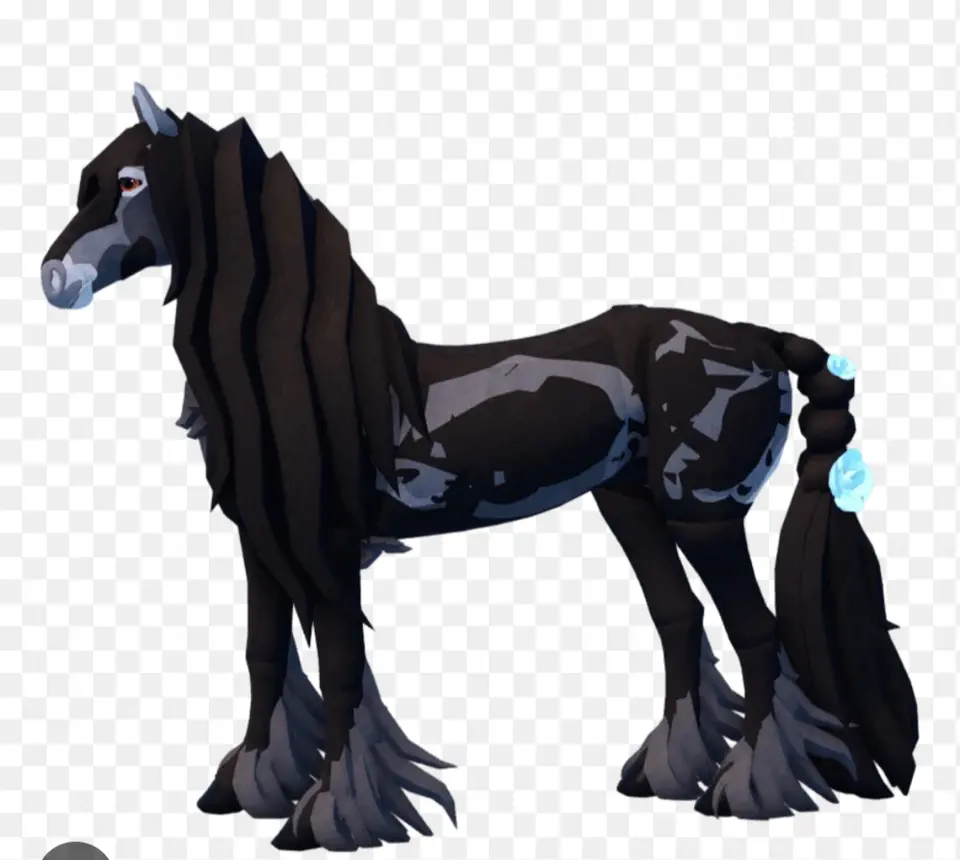
From Roblox to Reality: Why Friesian Horses Are So Expensive
Why games always make the Friesian the expensive one
Game designers pick breeds the way players recognise them. The Friesian is instantly identifiable, entirely black, heavily feathered, with a mane most players assume is exaggerated until they see a real one.
It is also genuinely rare and genuinely expensive in the real world, so making it a top-tier unlock is accurate rather than arbitrary. The games are reflecting a real market, and the scarcity they model is real scarcity.
What games cannot model is why. In a game, the Friesian is expensive because it is the reward. In reality, it is expensive because of a near-extinction, a very strict studbook, and an approval process that rejects almost every stallion presented to it.
The breed almost disappeared
This is the part the games leave out, and it is the reason the breed is what it is.
The Friesian comes from Friesland in the northern Netherlands and is one of Europe's oldest breeds, used for centuries as a carriage and light draught horse. Then agriculture mechanised. Tractors replaced working horses, crossbreeding diluted the purebred population, and by the early twentieth century the Friesian had collapsed to a few hundred breeding mares.
The breed survived because of a studbook founded in 1879, the Koninklijk Friesch Paarden-Stamboek, which refused to relax its standards even when the population was at its lowest. Every registered Friesian alive today descends from that small surviving group.
That history explains both the price and the strictness. When a breed comes back from a few hundred animals, the registry that saved it does not become casual afterwards.
Why so few Friesians exist
The single biggest driver of Friesian scarcity is stallion approval.
To breed registered Friesians, a stallion must be approved by the KFPS, and the process is deliberately brutal. Colts are assessed on conformation and movement, progress to a central examination, and then undergo performance testing under saddle and in harness, over a period of years. Only a small fraction of those presented make it through, and it is normal for the number of newly approved stallions in a given year to be in single digits. Approval can even be withdrawn later based on the quality of a stallion's offspring.
Mares are evaluated too, through a predicate system that awards ster, kroon and model according to conformation, movement and performance. We explain the whole vocabulary in what KFPS registration and predicates mean.
The result is a small population, tightly controlled, with verified pedigree behind every registered animal. That is what you are paying for, and it is why two black horses that look identical can differ enormously in price.
What a real Friesian actually costs
Purchase price varies enormously with age, training, sex, pedigree and predicates. A young, unstarted horse without predicates is a very different proposition from a mature, well-trained horse by an approved stallion out of a ster mare. We deliberately do not publish a single figure, because any number quoted without those variables is misleading.
What is more useful to understand is that the purchase price is not the main cost.
Owning a horse means paying, every year, for:
- Board or land, and shelter
- Feed for a horse standing 15.2 to 17 hands
- Farrier visits every five to eight weeks, indefinitely
- Routine veterinary care, vaccinations and dentistry
- An emergency veterinary reserve, because colic surgery costs what a used car costs
- Insurance
- Tack, correctly fitted
- Riding instruction
- Grooming and skin care, which for a feathered breed is a genuine ongoing commitment
In a game, you buy the horse once. In reality, the purchase is the beginning of an annual commitment that continues for the twenty or more years the horse lives. This is the single most important difference between the game and the reality, and it is worth understanding early.
What the games get right
More than you might expect.
The rarity is real. Friesians genuinely are a limited population with tightly controlled breeding.
The look is real. The mane, the tail, the feathering and the trot are not artistic exaggeration. If anything, the games understate the movement.
The temperament is real. Games that portray Friesians as calm and people-loving are accurate. It is one of the breed's genuine strengths.
The colour is real. Registered Friesians are very nearly always black. That is a breed standard, not a game design decision.
What the games get wrong
Horses need daily care. Not a stable slot. Feeding, mucking out, turnout, grooming, checking legs, picking out feet, every day, in every weather, whether or not you feel like riding.
Nothing is instant. Building a partnership with a horse takes months. Training takes years. A horse that has been sitting in a field for six months does not come out ready to ride.
Horses get hurt and get sick. Vet bills arrive without warning. Some injuries end a horse's ridden career. This is the part games never model and it is the part that most affects real owners.
They cannot be sold and re-bought casually. A horse is a living animal with a welfare interest in a stable home, not an asset to flip.
Riding is hard. The skills that let someone ride a large, powerful horse well take years to build, and no amount of game experience transfers.
If you are young and you want one for real
This is genuinely achievable, and the path is well-worn.
Start with lessons. A good riding school is where every real horse owner begins. You will learn to ride properly and, just as importantly, learn what daily horse care actually involves.
Volunteer at a yard. Nothing tells you whether you want this life like mucking out on a cold morning. Yards are usually glad of the help, and it is the fastest way to learn.
Ride as many horses as you can. Riding one horse teaches you that horse. Riding twenty teaches you to ride.
Learn the breed properly. Read about conformation, predicates, bloodlines and health testing. When the time comes, you will be able to read a pedigree instead of trusting a photograph.
Be realistic about the first horse. Almost nobody's first horse should be a young Friesian, however much you want one. We have written honestly about whether a Friesian suits a first-time owner, and it is worth reading before you set your heart on a specific animal. It may also be worth considering how Friesians compare with Morgans, because for a first horse the practical answer is often a different breed.
Save for the year, not the purchase. The owners who succeed are the ones who budgeted for the annual cost before they bought.
None of that is discouragement. Plenty of people who started exactly where you are now own Friesians today. It just took the route through lessons, yard work and patience rather than a single purchase.
Frequently Asked Questions
In Conclusion
The Friesian is the expensive black horse in the game because it is the expensive black horse in real life. The scarcity is genuine, built on a near-extinction and maintained by a studbook that approves only a handful of stallions a year, and the beauty that made you want one is entirely real. What the game leaves out is the daily work, the annual cost and the years of skill-building that stand between wanting a Friesian and owning one well. That gap is bridgeable. Most people who cross it start with riding lessons and a willingness to muck out. If you would like to see what real Friesians look like with real paperwork, [browse our available Friesian horses](/horses) and read the details on a horse like [Olivier, a Friesian](/horses/olivier-friesian). And if you are years away but serious, [contact our team](/contact) with questions. We would much rather answer them now than sell someone a horse they were not ready for.